
What can you hear outside as you read this? I’ve just stopped to listen. A blackbird’s singing, and a song thrush, a robin and a mass of tits. As I step out of the back door, bees and flies are buzzing everywhere. A hoverfly hangs in the air right in front of me, and a bumble bee zooms past on its way to the Lungwort that’s flowering by the wall.
That’s why we’ve chosen to limit the mowing in our garden. In the last three years we’ve cut only paths through the lawn, letting the grass grow and all the wildflowers too. The wildlife in our garden has loved it, and so have we.
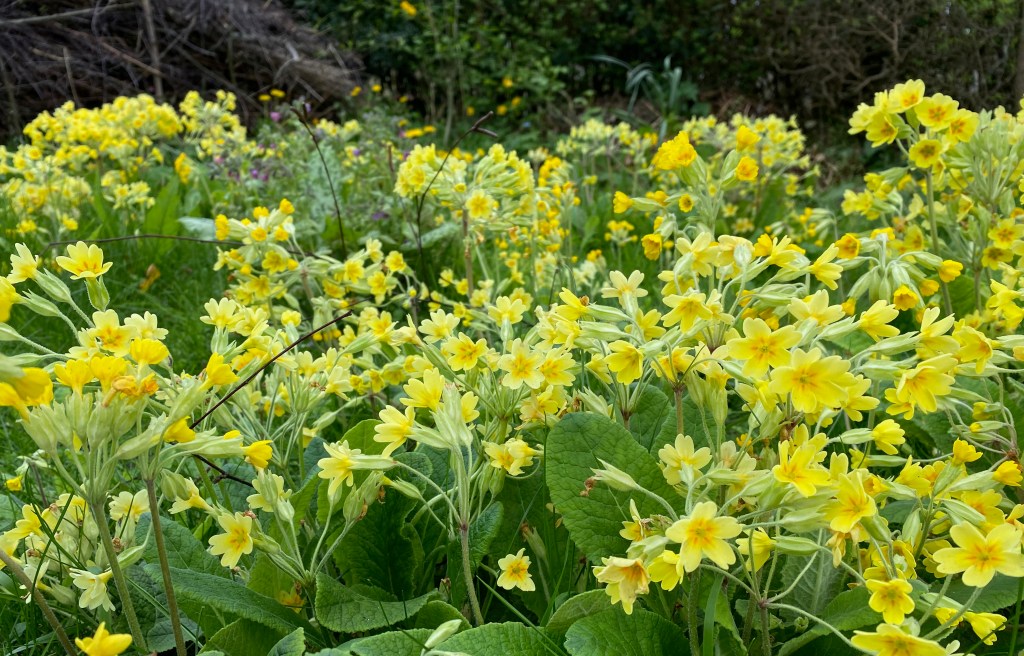
We’ve had glorious surprises too: a few years ago a single cowslip appeared under our birch tree, its seed probably dropped by a bird. We let it be, mowing around it, and it set seed. Now we have a mass of them glowing in the sunshine even on the darkest and wettest of days. Who knows what you might find if you leave part of your lawn uncut?
Our whole-garden approach isn’t for everyone but this year, why not leave an area of your garden unmown for the next month?
You’ll be in good company – the charity Plantlife encourages people across the UK to put their mowers away every May because even a small garden makes a big difference to our wildlife. Here’s what they say:
We’ve lost nearly 97% of flower rich meadows since the 1970’s and with them gone are vital food needed by pollinators, like bees and butterflies.
A healthy lawn with some long grass and wildflowers benefits wildlife, tackles pollution and can even lock away carbon below ground – and best of all, to reap these benefits all you have to do is not mow your lawn in May!
With over 20 million gardens in the UK, even the smallest grassy patches add up to a significant proportion of our land which, if managed properly, can deliver enormous gains for nature, communities and the climate.
Plantlife, April 2023
Imagine how much difference we could all make to the wildlife of Groombridge if we left part of our gardens uncut and liberated the wildflowers for a summer? We’d have beautiful flowers and our poor insects – in desperate decline even here in Groombridge – would have food and homes and the chance to thrive again.
PS The Lungwort we see in our gardens and hedges (Pulmonaria Officinalis) isn’t actually a wildflower in the UK, though there are two rare native Pulmonaria. It’s been in our gardens so long that it has spread to the wild, and even though it’s barely scented, pollinating insects love it – they’re probably drawn by its zinging colour. It does grow wild in continental Europe, though, so as our climate warms let’s hope it continues to thrive here.
 Wild Groombridge
nice ! good read .
stay awesome and keep blogging
http://www.pomeranianpuppies.uk
LikeLike
Thank you Jason – we hope to hear the sound of buzzing gardens this summer!
LikeLike